
 Kontakt
 Wie einkaufen
Versand
Kaufberater
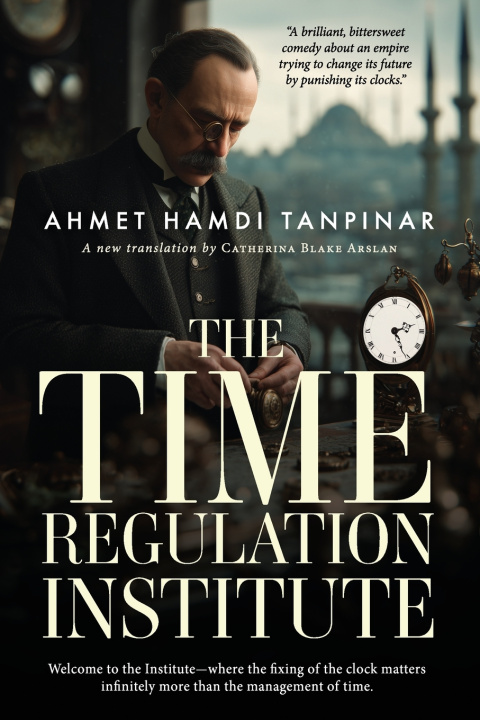
The Time Regulation Institute
 Englisch
 54 b
54 b
 Neu
Neu
 Lieferung in Griechenland
Bis zu 30 Tage Rückgaberecht
Das könnte Sie auch interessieren






When the eccentric Hayri İrdal and the visionary, hyper-capitalist Halit Ayarcı team up to create the "Time Regulation Institute," they unleash a bureaucratic monster. The goal? To ensure every public clock in the city is synchronized to the exact same second. The penalty for discrepancy? A fine calculated with exquisite, absurd mathematical precision. First published in 1961, this landmark novel instantly revolutionized Turkish literature, establishing itself as a brilliant, fiercely intelligent masterpiece that stands to this day as one of the crown jewels of world fiction. Through this dazzling premise, Ahmet Hamdi Tanpınar masterfully explores the bizarre, disorienting friction between traditional Ottoman life and the relentless march of Western modernization. It is a profound, thought-provoking examination of what happens when a society is forced to change its clocks before it is ready to change its mind. Wrapped in an intoxicating blend of Eastern mystique and Western modernism, the narrative unfolds with a rhythm that is as deeply philosophical as it is wildly, undeniably hilarious. For the Western reader who loves the surreal wit of Franz Kafka, the labyrinthine satire of Nikolai Gogol, or the playful irony of Jorge Luis Borges, The Time Regulation Institute is the ultimate literary discovery-a glittering, fiercely funny comedy of absolute absurdity. The new translation by Catherina Blake Arslan brilliantly captures the internal friction of a society caught between two worlds, shedding the academic stiffness of the past to transform Tanpınar's complex, ironic masterpiece into an effortlessly fluid, laugh-out-loud joyful read for the modern audience.
About this translation
Published as a book in 1961 after years of serialization, this novel stands as an undisputed titan of 20th-century Turkish literature. Yet, for a long time, it remained one of the global literary canon's best-kept secrets.
For the Western reader, Tanpınar's masterpiece offers something far more profound than a localized satire of a developing nation. It is an extraordinary, funhouse-mirror reflection of the West's own obsession with efficiency, progress, and bureaucracy. If Franz Kafka's The Castle captured the terrifying, alienating dread of modern institutions, Tanpınar offers its brilliant, comedic counterweight: the absurdity of a bureaucracy that exists solely to justify its own existence. It is a universal tale of human adaptability, psychological defense mechanisms, and the bizarre lengths to which a society will go to appear "modern."
Tanpınar lived through the collapse of the multi-ethnic, traditionalist Ottoman Empire and the rapid, top-down birth of the secular, Western-facing Republic of Turkey under Mustafa Kemal Atatürk.
Overnight, deep-rooted cultural landmarks were altered. The state mandated a shift from the Arabic script to the Latin alphabet and initiated a aggressive linguistic purge, attempting to replace centuries of Persian- and Arabic-inflected Ottoman Turkish with a streamlined, "pure" Turkish idiom. The goal was unambiguous: turn the nation's gaze fully toward Europe and the future, cutting chords with a stagnant past.
Tanpınar, a poet, academic, and cultural conservative in the truest, non-political sense, watched this transformation with deep ambivalence. He did not reject Westernization-he loved its music, its philosophy, and its novelistic forms-but he mourned the violent psychological fracturing of a populace torn between two incompatible clocks. The Time Regulation Institute was born from this exact cultural schizophrenia. The book acts as a grand allegory for a country forced to change its rhythm mid-stride, synchronizing its traditional, prayer-oriented worldview with the unforgiving, mechanical tick of Western capitalism.


Informationen zum Buch
Englisch

Verschenken Sie dieses Buch noch heute
Es ist ganz einfach
1 Legen Sie das Buch in Ihren Warenkorb und wählen Sie den Versand als Geschenk 2 Wir schicken Ihnen umgehend einen Gutschein 3 Das Buch wird an die Adresse des beschenkten Empfängers geliefertHallo! Ich bin Libroamiko, dein Buchberater.
Wie kann ich dir helfen?