Επικοινωνία
 Πώς να κάνετε αγορές;
Παράδοση
Οδηγός αγορών
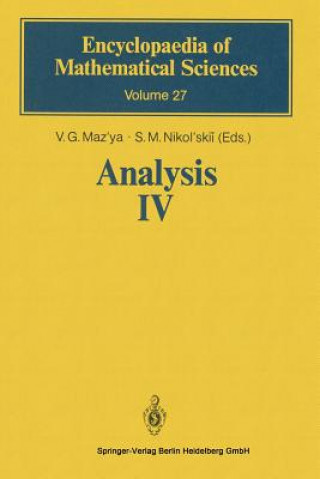
Analysis IV
Linear and Boundary Integral Equations
 Αγγλική
 125 b
125 b
 Παράδοση στην Ελλάδα
30 ημέρες για την επιστροφή των προϊόντων
Οι πελάτες αγόρασαν επίσης








 /
/
 Χαρτόδετο
 56.88
€
56.88
€










A linear integral equation is an equation of the form XEX. (1) 2a(x)cp(x) - Ix k(x, y)cp(y)dv(y) = f(x), Here (X, v) is a measure space with a-finite measure v, 2 is a complex parameter, and a, k, f are given (complex-valued) functions, which are referred to as the coefficient, the kernel, and the free term (or the right-hand side) of equation (1), respectively. The problem consists in determining the parameter 2 and the unknown function cp such that equation (1) is satisfied for almost all x E X (or even for all x E X if, for instance, the integral is understood in the sense of Riemann). In the case f = 0, the equation (1) is called homogeneous, otherwise it is called inhomogeneous. If a and k are matrix functions and, accordingly, cp and f are vector-valued functions, then (1) is referred to as a system of integral equations. Integral equations of the form (1) arise in connection with many boundary value and eigenvalue problems of mathematical physics. Three types of linear integral equations are distinguished: If 2 = 0, then (1) is called an equation of the first kind; if 2a(x) i= 0 for all x E X, then (1) is termed an equation of the second kind; and finally, if a vanishes on some subset of X but 2 i= 0, then (1) is said to be of the third kind.


Πληροφορίες για το βιβλίο
Αγγλική

Χαρίστε αυτό το βιβλίο σήμερα
Είναι εύκολο
1 Προσθέστε το βιβλίο στο καλάθι σας και επιλέξτε παράδοση ως δώρο 2 Ως ανταμοιβή θα σας στείλουμε ένα κουπόνι 3 Το βιβλίο θα φτάσει στη διεύθυνση του παραλήπτηΜπορεί να σας ενδιαφέρει







 /
Χαρτόδετο
52.13
€
/
Χαρτόδετο
52.13
€












 /
Χαρτόδετο
47.28
€
/
Χαρτόδετο
47.28
€