
 Επικοινωνία
 Πώς να κάνετε αγορές;
Παράδοση
Οδηγός αγορών
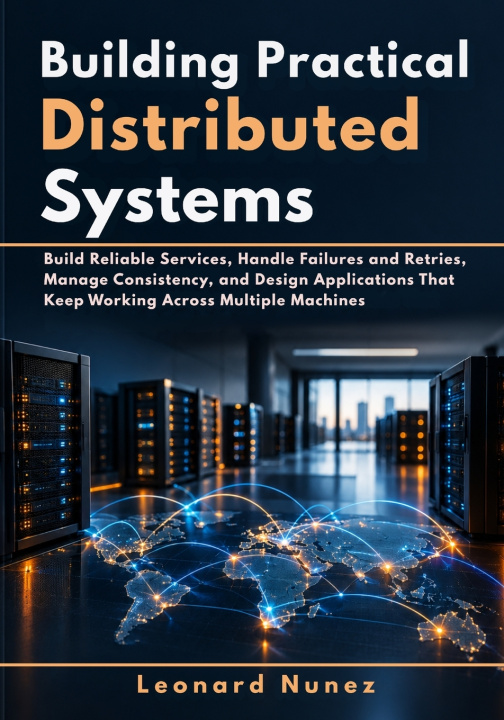
Building Practical Distributed Systems
Build Reliable Services, Handle Failures and Retries, Manage Consistency, and Design Applications That Keep Working Across Multiple Machines
 Αγγλική
 74 b
74 b
 Νέα
Νέα
 Παράδοση στην Ελλάδα
Έως 30 ημέρες για επιστροφή

What happens when the application logic that worked perfectly on one machine suddenly has to work across multiple services, processes, databases, and machines?
A network call can fail without telling you whether the operation succeeded. A retry can create duplicate work. A database update can succeed while its event never reaches another service. Data can be correct in one place and stale in another. As systems grow, failures that were once simple errors become problems of uncertainty, timing, coordination, consistency, and recovery.
Building Practical Distributed Systems teaches you how to design applications that continue working when those failures occur.
Instead of treating distributed systems as a collection of abstract theories, this book takes a practical, problem-solving approach. You will build and evolve an order-processing system while encountering the kinds of failures that developers must account for in real distributed applications. Each new problem introduces a distributed-systems principle, applies it to the system, and then tests whether the protection actually works.
You will learn how to:
- Understand what changes when application components communicate across machines
- Design effective timeouts and deadlines for remote operations
- Use retries without creating retry storms or amplifying failures
- Make operations safe to repeat through idempotent design
- Reason about unknown outcomes when a remote operation times out
- Understand consistency, replication, and stale data
- Reliably coordinate database changes with asynchronous events
- Handle duplicate messages and recover failed background processing
- Design multi-step workflows when one global transaction is not available
- Distribute workloads without creating damaging hot spots
- Apply backpressure, resource limits, and workload isolation
- Contain cascading failures across dependent services
- Use logs, metrics, and distributed tracing to find the real source of a failure
- Test distributed systems against delays, duplication, overload, partial failure, and recovery scenarios
Whether you are moving from traditional application development into distributed systems or want a stronger practical foundation for building reliable services, this book gives you a structured way to reason about systems that operate across multiple machines.
Build the system. Break it deliberately. Understand why it failed. Engineer the protection. Verify that it works.
If you want to build distributed applications that remain reliable when networks slow down, requests repeat, data becomes stale, messages are redelivered, and individual components fail, Building Practical Distributed Systems is the practical guide to add to your technical library.


Πληροφορίες για το βιβλίο
Αγγλική

Χαρίστε αυτό το βιβλίο σήμερα
Είναι εύκολο
1 Προσθέστε το βιβλίο στο καλάθι σας και επιλέξτε παράδοση ως δώρο 2 Ως ανταμοιβή θα σας στείλουμε ένα κουπόνι 3 Το βιβλίο θα φτάσει στη διεύθυνση του παραλήπτηΓεια σας! Είμαι ο Libroamiko, ο σύμβουλος βιβλίων σας.
Πώς μπορώ να σας βοηθήσω;