Επικοινωνία
 Πώς να κάνετε αγορές;
Παράδοση
Οδηγός αγορών
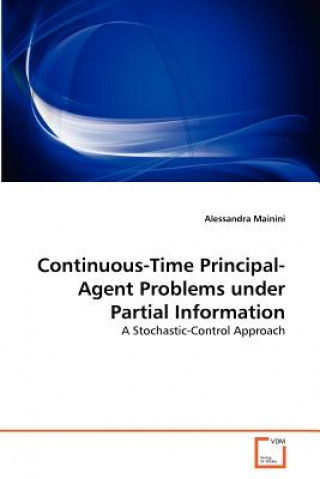
Continuous-Time Principal-Agent Problems under Partial Information
 Αγγλική
 121 b
121 b
 Παράδοση στην Ελλάδα
30 ημέρες για την επιστροφή των προϊόντων
Οι πελάτες αγόρασαν επίσης
 /
/
 Χαρτόδετο
 9.11
€
9.11
€



 /
Χαρτόδετο
17.11
€
/
Χαρτόδετο
17.11
€



 /
Χαρτόδετο
16.20
€
/
Χαρτόδετο
16.20
€





 /
Χαρτόδετο
13.36
€
/
Χαρτόδετο
13.36
€


 /
Χαρτόδετο
80.10
€
/
Χαρτόδετο
80.10
€


Moral hazard is a key issue in principal-agent literature. Examples lie in several aspects of real life, such as the worker's lack of effort when his/her conduct cannot be directly observed by the employer, and the principal's consequent need to motivate the agent to work as much as possible in his/her best interests. Another example is the relationship between voters and politicians, where elections serve as a disciplining mechanism to prevent rent-seeking behavior by unobserved public administrators. In this work we analyze such problems in a continuous-time setting with a model specification that draws from the classical consumption/investment ŕ la Merton. Agents differ in competence, which is incompletely (but symmetrically) known by all players and learned over time by observing agent's performance. From a mathematical point of view, the analysis uses classical filtering techniques to re-formulate the problem within a complete information setting; then, relying on the dynamic programming principle and by using a guess-and-verify approach, explicit (at least to some extent) solutions are provided.


Πληροφορίες για το βιβλίο
Αγγλική
Κατηγορία

Χαρίστε αυτό το βιβλίο σήμερα
Είναι εύκολο
1 Προσθέστε το βιβλίο στο καλάθι σας και επιλέξτε παράδοση ως δώρο 2 Ως ανταμοιβή θα σας στείλουμε ένα κουπόνι 3 Το βιβλίο θα φτάσει στη διεύθυνση του παραλήπτηΜπορεί να σας ενδιαφέρει
 /
Χαρτόδετο
60.05
€
/
Χαρτόδετο
60.05
€






 /
Χαρτόδετο
114.64
€
/
Χαρτόδετο
114.64
€
 /
Σκληρόδετο
41.82
€
/
Σκληρόδετο
41.82
€