
 Επικοινωνία
 Πώς να κάνετε αγορές;
Παράδοση
Οδηγός αγορών
 Αγγλική
 40 b
40 b
 Νέα
Νέα
 Παράδοση στην Ελλάδα
Έως 30 ημέρες για επιστροφή

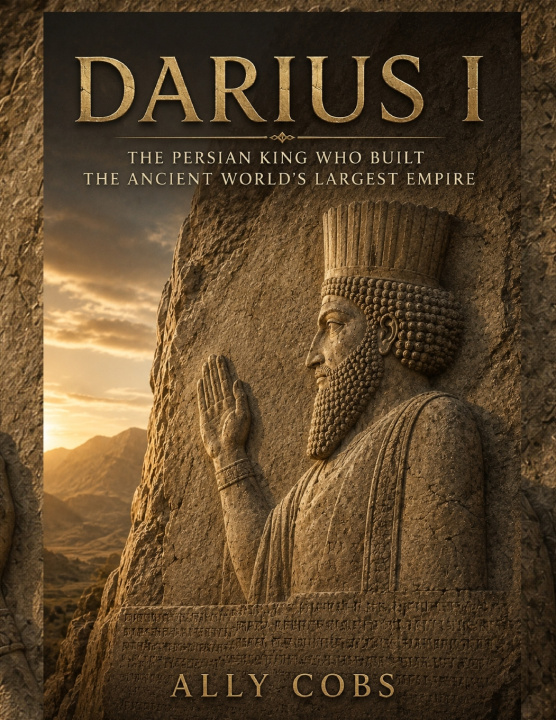
A king was dead, and the man who took his place had no ears.
That single, strange detail, the difference between a legitimate prince and an impostor wearing his face, set off one of the most consequential power struggles in the ancient world. When the dust settled, a distant nobleman named Darius stood as ruler of the largest empire the earth had yet known, and he had a mountainside carved with his version of how he got there.
This book traces the full and remarkable story of Darius I, from the disputed circumstances of his rise, a secret murder, a priest impersonating a prince, a conspiracy of seven armed noblemen, and a horse race rigged before it began, through nearly four decades of rule that transformed a fragile inheritance into a lasting empire. Readers will follow Darius as he crushes nine separate rebellions in the earliest years of his reign, including the dramatic siege of Babylon broken open by a general who mutilated himself to gain his enemy's trust. They will see him build the institutions that held his empire together long after the fighting ended: a standardized currency, a road system so effective that its praise still echoes in a modern postal motto, and a policy of religious tolerance that allowed dozens of distinct peoples to live under a single crown. And they will follow him east to the Indus Valley, north into a frustrating campaign against the nomadic Scythians, and finally west into a fateful conflict with Greece that would end in defeat at Marathon and pass, unfinished, to his son Xerxes.
Drawing on the Behistun inscription that Darius commissioned about his own reign and the accounts of the Greek historian Herodotus, this book presents the full, complicated portrait of a ruler whose true legitimacy remains genuinely uncertain even now. It does not pretend to resolve that uncertainty. Instead, it invites readers to weigh the evidence themselves, to understand how ancient rulers built and defended their claims to power, and to see how one man's decisions, in the earliest and most dangerous days of his reign, shaped the trajectory of an empire and, in time, the future of the ancient Near East.
Readers of ancient history, Persian history, and the era of the Greco-Persian Wars will find here a narrative that moves from palace conspiracy to monumental architecture, from battlefield strategy to the quiet, human moments that rarely survive in the historical record but linger long after the reading is done.
Darius called himself King of Kings. This is the story of the empire he built to prove it.


Πληροφορίες για το βιβλίο
Αγγλική

Χαρίστε αυτό το βιβλίο σήμερα
Είναι εύκολο
1 Προσθέστε το βιβλίο στο καλάθι σας και επιλέξτε παράδοση ως δώρο 2 Ως ανταμοιβή θα σας στείλουμε ένα κουπόνι 3 Το βιβλίο θα φτάσει στη διεύθυνση του παραλήπτηΓεια σας! Είμαι ο Libroamiko, ο σύμβουλος βιβλίων σας.
Πώς μπορώ να σας βοηθήσω;