
 Επικοινωνία
 Πώς να κάνετε αγορές;
Παράδοση
Οδηγός αγορών
 Αγγλική
 249 b
249 b
 Παράδοση στην Ελλάδα
Έως 30 ημέρες για επιστροφή
Οι πελάτες αγόρασαν επίσης


















 /
/
 Χαρτόδετο
 25.12
€
25.12
€

 /
Χαρτόδετο
39.14
€
/
Χαρτόδετο
39.14
€

 /
Χαρτόδετο
49.84
€
/
Χαρτόδετο
49.84
€

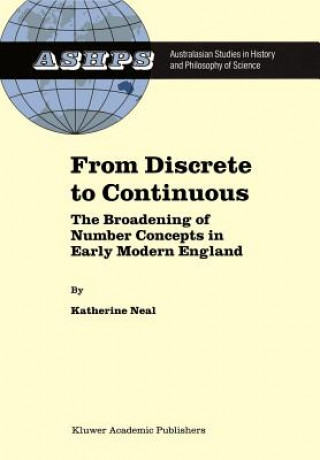
In the early modern period, a crucial transformation occurred in the classical conception of number and magnitude. Traditionally, numbers were merely collections of discrete units that measured some multiple. Magnitude, on the other hand, was usually described as being continuous, or being divisible into parts that are infinitely divisible. This traditional idea of discrete number versus continuous magnitude was challenged in the early modern period in several ways.§This detailed study explores how the development of algebraic symbolism, logarithms, and the growing practical demands for an expanded number concept all contributed to a broadening of the number concept in early modern England. An interest in solving practical problems was not, in itself, enough to cause a generalisation of the number concept. It was the combined impact of novel practical applications together with the concomitant development of such mathematical advances as algebraic notation and logarithms that produced a broadened number concept.


Πληροφορίες για το βιβλίο
Αγγλική

Χαρίστε αυτό το βιβλίο σήμερα
Είναι εύκολο
1 Προσθέστε το βιβλίο στο καλάθι σας και επιλέξτε παράδοση ως δώρο 2 Ως ανταμοιβή θα σας στείλουμε ένα κουπόνι 3 Το βιβλίο θα φτάσει στη διεύθυνση του παραλήπτηΜπορεί να σας ενδιαφέρει



















 /
Χαρτόδετο
25.92
€
/
Χαρτόδετο
25.92
€



Γεια σας! Είμαι ο Libroamiko, ο σύμβουλος βιβλίων σας.
Πώς μπορώ να σας βοηθήσω;