
 Επικοινωνία
 Πώς να κάνετε αγορές;
Παράδοση
Οδηγός αγορών
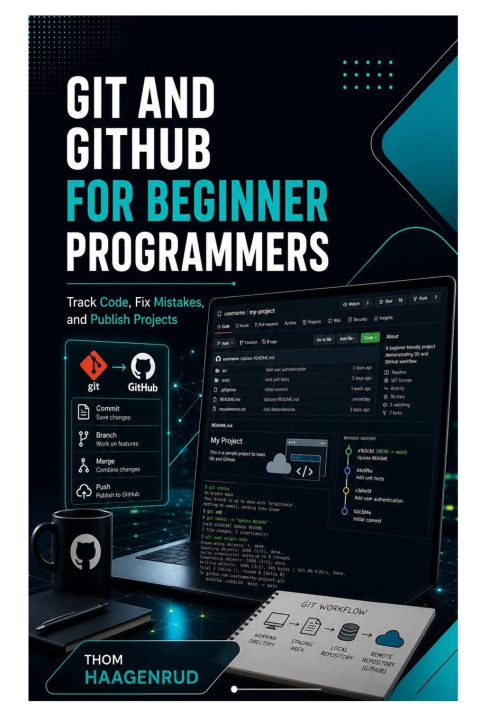
Git and GitHub for Beginner Programmers
Track Code, Fix Mistakes, and Publish Projects
 Αγγλική
 49 b
49 b
 Προετοιμαζουμε
 Νέα
Νέα
 Παράδοση στην Ελλάδα
Έως 30 ημέρες για επιστροφή

Do you want to learn Git and GitHub without memorizing random commands you do not fully understand?
Git and GitHub for Beginner Programmers is a practical, beginner-friendly guide to version control, repository management, collaboration, recovery, automation, and project publishing. Written for beginner programmers, students, self-taught developers, career switchers, bootcamp learners, junior developers, and working professionals who have used Git without understanding it fully, this book teaches Git and GitHub through repository state, safe workflows, practical recovery, and a complete published portfolio project.
Instead of treating Git as a list of commands to copy, this book teaches you how to inspect what changed, understand where those changes exist, choose the right operation, and verify the repository state afterward. You will learn the difference between Git and GitHub, between working files and commits, between local branches and remote branches, and between saving work and sharing work.
The teaching method is based on repository state. You will repeatedly ask: Which repository am I in? Which branch is current? What has changed? Is the change staged, committed, or shared? What should exist after this command? That inspect, act, verify pattern helps you move from copying commands to making controlled version-control decisions.
The book also emphasizes recovery. You will learn how to diagnose before undoing, how to unstage without discarding work, how to restore files, how to reverse published changes, how to use reset carefully, how to recover with the reflog, and how to avoid destructive commands until you understand what they will affect.
GitHub is taught as more than a place to upload code. You will learn how repositories become collaborative workspaces through remotes, pull requests, reviews, issues, forks, templates, protected branches, required checks, repository documentation, security files, releases, automated workflows, and GitHub Pages deployment.
This book also teaches professional habits that extend beyond Git. You will learn to make one purposeful change at a time, inspect before acting, keep history understandable, verify commands through evidence, protect credentials, avoid rewriting shared history carelessly, test integrated work, review changes before acceptance, document assumptions, automate repeatable checks, maintain stable default branches, and treat recovery as a normal engineering skill.
No previous Git or GitHub experience is required. You should be able to create folders, edit plain-text files, install software, use a basic code editor, enter short terminal commands, and recognize simple source-code or documentation files. Most early exercises use plain text and Markdown so attention stays on Git rather than on a programming language.
Whether you are a student submitting assignments, a self-taught developer building a portfolio, a career switcher entering software development, a bootcamp learner, a junior developer joining a team, or a programmer who has relied on graphical Git tools without understanding the command line, this book gives you a structured path into safe, practical version control.
Stop treating Git as a panic tool you use only when something goes wrong. Learn how to track code, inspect changes, create clean commits, fix mistakes, work with branches, collaborate through GitHub, automate checks, publish releases, deploy a portfolio project, and manage repositories with professional judgment.


Πληροφορίες για το βιβλίο
Αγγλική

Χαρίστε αυτό το βιβλίο σήμερα
Είναι εύκολο
1 Προσθέστε το βιβλίο στο καλάθι σας και επιλέξτε παράδοση ως δώρο 2 Ως ανταμοιβή θα σας στείλουμε ένα κουπόνι 3 Το βιβλίο θα φτάσει στη διεύθυνση του παραλήπτηΓεια σας! Είμαι ο Libroamiko, ο σύμβουλος βιβλίων σας.
Πώς μπορώ να σας βοηθήσω;