
 Επικοινωνία
 Πώς να κάνετε αγορές;
Παράδοση
Οδηγός αγορών
 Αγγλική
 105 b
105 b
 Νέα
Νέα
 Παράδοση στην Ελλάδα
Έως 30 ημέρες για επιστροφή

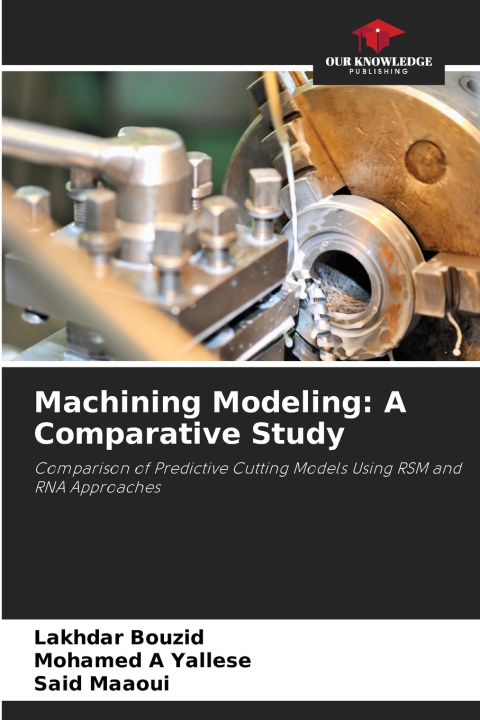
During machining, the conditions for success are determined in the cutting zone. In this context, the relationship between cutting conditions (cutting speed, feed rate, depth of cut, and tool type) and surface roughness (Ra and Rt) represents a major industrial objective. This work focuses on an experimental study examining the effects of cutting parameters on surface roughness, obtained during the machining of 42Cd4 steel (AISI 4140) hardened to 60 HRC, machined via dry hard turning using ceramic and metal carbide tools. The study is divided into two parts: the first focuses on proposing mathematical models to predict surface roughness, based on two modeling methods: the response surface methodology (RSM) and artificial neural networks (ANNs). The second part involves comparing the results of the two modeling methods-RSM and ANNs-in order to select the most effective one. Based on the comparative study, the ANN models proved to be better at predicting surface roughness within the range of the experiments conducted than the SRM models.


Πληροφορίες για το βιβλίο
Αγγλική
Κατηγορία

Χαρίστε αυτό το βιβλίο σήμερα
Είναι εύκολο
1 Προσθέστε το βιβλίο στο καλάθι σας και επιλέξτε παράδοση ως δώρο 2 Ως ανταμοιβή θα σας στείλουμε ένα κουπόνι 3 Το βιβλίο θα φτάσει στη διεύθυνση του παραλήπτηΓεια σας! Είμαι ο Libroamiko, ο σύμβουλος βιβλίων σας.
Πώς μπορώ να σας βοηθήσω;