
 Επικοινωνία
 Πώς να κάνετε αγορές;
Παράδοση
Οδηγός αγορών
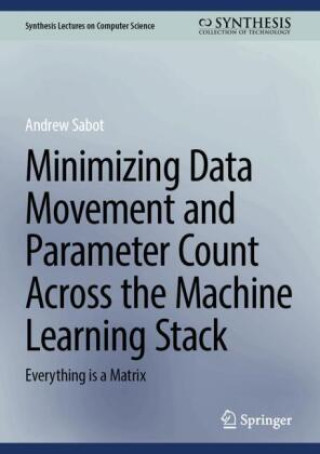
Minimizing Data Movement and Parameter Count Across the Machine Learning Stack
Everything is a Matrix
 Αγγλική
 109 b
109 b
 Παράδοση στην Ελλάδα
Έως 30 ημέρες για επιστροφή
Οι πελάτες αγόρασαν επίσης



 Χαρτόδετο
 17.79
€
17.79
€







 /
Χαρτόδετο
29.65
€
/
Χαρτόδετο
29.65
€








This book provides a focused, research-forward guide to making large AI models efficient in practice and also presents an array of novel techniques to reduce memory footprint, accelerate computation, and improve overall hardware utilization. The author demonstrates that substantial efficiency gains can be achieved by rethinking how data is computed, stored, and compressed, with a special focus on matrices, the core computational structure underpinning both scientific computing and neural networks. Modern AI models run on huge grids of numbers (matrices/tensors), and their speed and affordability depend on how those numbers are arranged and processed on real hardware (GPUs/TPUs/CPUs). This book explains practical methods to skip unnecessary work (structured sparsity), move data efficiently (gather/scatter), and shrink models without losing accuracy (block distillation) so that AI systems can use less memory, less time, and less energy without sacrificing quality. In addition, the book shows how to turn algorithmic ideas into hardware-aware speedups on GPUs/TPUs. Readers will learn when sparsity pays off, how to schedule irregular workloads, and how to recover accuracy in compressed models. Case studies illustrate end-to-end design choices, evaluation, and pitfalls. The result is a coherent perspective that bridges theory, compilers/run times, and real-world deployment.


Πληροφορίες για το βιβλίο
Αγγλική

Χαρίστε αυτό το βιβλίο σήμερα
Είναι εύκολο
1 Προσθέστε το βιβλίο στο καλάθι σας και επιλέξτε παράδοση ως δώρο 2 Ως ανταμοιβή θα σας στείλουμε ένα κουπόνι 3 Το βιβλίο θα φτάσει στη διεύθυνση του παραλήπτηΜπορεί να σας ενδιαφέρει












 /
Χαρτόδετο
57.71
€
/
Χαρτόδετο
57.71
€


 /
Σκληρόδετο
159.97
€
/
Σκληρόδετο
159.97
€










Γεια σας! Είμαι ο Libroamiko, ο σύμβουλος βιβλίων σας.
Πώς μπορώ να σας βοηθήσω;