
 Επικοινωνία
 Πώς να κάνετε αγορές;
Παράδοση
Οδηγός αγορών
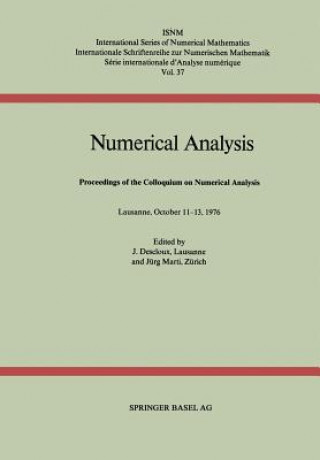
Numerical Analysis
Proceedings of the Colloquium on Numerical Analysis Lausanne, October 11-13, 1976
 Αγγλική
 125 b
125 b
 Παράδοση στην Ελλάδα
Έως 30 ημέρες για επιστροφή
Οι πελάτες αγόρασαν επίσης




Nowadays aluminium is essentially produced according to the Hall-H~roult process, in other words, by electrolysis of alumina A1 0 desolved in molten cryolite Na A1F at a 2 3 3 6 temperature of about 950 °C. In a reduction plant cells are connected in series. For technical and economical reasons, it is advisable to choose large nominal currents (150 kAle For such intensities, the electromagnetic effects in the cells become important. In particular, these effects bring about movements in the liauid metal, as well as interface variations in level, that are detrimental to efficiencv and energy consumption [l,~ . For an optimal design, it is necessary to predetermine the electromagnetic behaviour of each new typ of cells. It is specially necessary to calculate the repartition of the current density in each point of the cell (electric problem), and the magnetic induction produced in the liquid metal by the currents circulating in the cell itself, in the near cells and in the external conductors (magnetic problem). Electric problem formulation Stationary electric phenomena are described by the equations ~ . . . rotE=O (1) . . . divJ=O (2) t=f1 (3) The first equation can be replaced by t=-g;tdU (4) where U is the electric potential. J. -M. BLANC 131 ~ -+ We can eliminate E and J between the equations above. In an homogeneous material, we obtain a Laplace's equation (5) 4u=0 On surfaces separating material of different resistivities, . . . .


Πληροφορίες για το βιβλίο
Αγγλική

Χαρίστε αυτό το βιβλίο σήμερα
Είναι εύκολο
1 Προσθέστε το βιβλίο στο καλάθι σας και επιλέξτε παράδοση ως δώρο 2 Ως ανταμοιβή θα σας στείλουμε ένα κουπόνι 3 Το βιβλίο θα φτάσει στη διεύθυνση του παραλήπτηΜπορεί να σας ενδιαφέρει



 /
/
 Χαρτόδετο
 13.65
€
13.65
€


Γεια σας! Είμαι ο Libroamiko, ο σύμβουλος βιβλίων σας.
Πώς μπορώ να σας βοηθήσω;