
 Επικοινωνία
 Πώς να κάνετε αγορές;

Παράδοση
Οδηγός αγορών
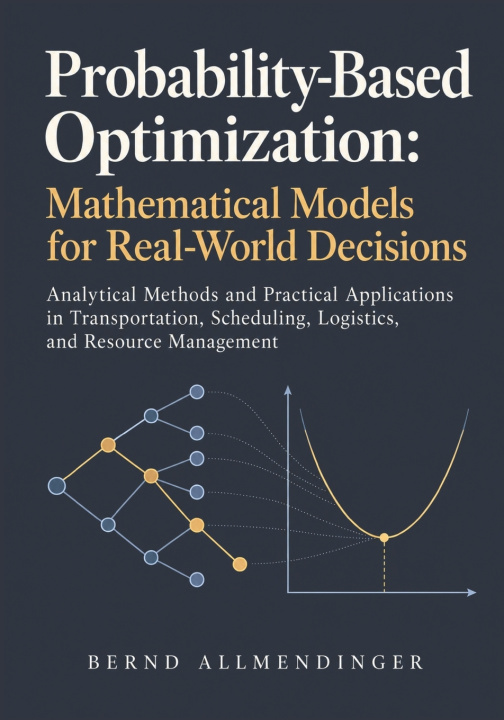
Probability-Based Optimization
Mathematical Models for Real-World Decisions: Analytical Methods and Practical Applications in Transportation, Scheduling, Logistics, and Resource Management
 Αγγλική
 50 b
 Νέα
 Παράδοση στην Ελλάδα
Έως 30 ημέρες για επιστροφή

How much spare capacity is enough? How early should production begin? Which job should come first when completion times are uncertain?
Probability-Based Optimization: Mathematical Models for Real-World Decisions explores these questions through 39 practical problems in transportation, scheduling, logistics and resource management.
Each problem begins with a clear decision and a small, manageable example. The calculation is developed step by step: define the uncertainty, describe the possible outcomes, calculate their probabilities and compare the available choices. The discussion then moves beyond the original numbers to more general formulas, distributions and decision rules.
This progression is central to the book. Readers first see how a model works in a simple case, then discover what changes when demand becomes continuous, durations vary, events depend on one another or decisions must adapt to new information. Generalisations grow out of familiar examples, with their assumptions and limits explained.
Topics include:
Booking limits, spare capacity and inventory decisions.
Departure allowances, waiting times and production lead times.
Transport sequences, project reserves and machine failure.
Dynamic storage decisions and the value of additional information.
Linear costs and selected extensions to quadratic and other nonlinear costs.
Worked examples, decision trees, state diagrams and distribution plots support the mathematics throughout. Formulas are explained in words, recursions are developed from their underlying events, and alternative solution methods are introduced where they add insight. Explicit formulas are derived where available; other models are solved through carefully explained finite calculations and recursions.
Each chapter closes by interpreting the result: what to choose, what the expected outcome means, what uncertainty remains and which assumptions support the recommendation. A concise mathematical toolkit and guided reading suggestions provide further support.
Written for readers with basic mathematical knowledge, the book offers an approachable starting point and increasingly substantial extensions. Its aim is to help readers understand how probability becomes a reasoned decision-and how a simple example can lead to a much more general solution.


Πληροφορίες για το βιβλίο
Αγγλική
Κατηγορία

Χαρίστε αυτό το βιβλίο σήμερα
Είναι εύκολο
1 Προσθέστε το βιβλίο στο καλάθι σας και επιλέξτε παράδοση ως δώρο 2 Ως ανταμοιβή θα σας στείλουμε ένα κουπόνι 3 Το βιβλίο θα φτάσει στη διεύθυνση του παραλήπτηΓεια σας! Είμαι ο Libroamiko, ο σύμβουλος βιβλίων σας.
Πώς μπορώ να σας βοηθήσω;