
 Επικοινωνία
 Πώς να κάνετε αγορές;
Παράδοση
Οδηγός αγορών
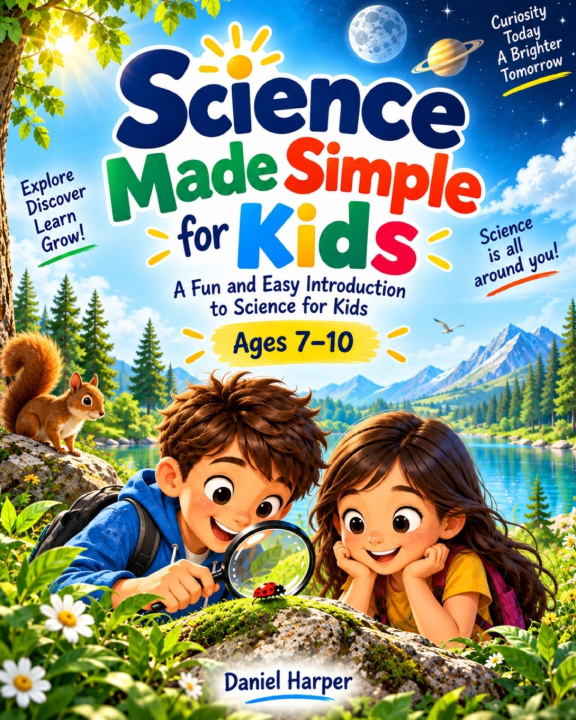
Science Made Simple for Kids
A Fun and Easy Introduction to Science for Kids Ages 7-10
 Αγγλική
 40 b
40 b
 Νέα
Νέα
 Παράδοση στην Ελλάδα
Έως 30 ημέρες για επιστροφή

What if learning science felt less like studying and more like discovering how the world works?
Why does ice melt?
How does a plant grow from a tiny seed?
Why does a ball move when you kick it?
Where does rain come from?
How do magnets pull things without touching them?
And what makes something alive?
These are the kinds of questions that make science exciting-and they are exactly where this book begins.
Science Made Simple for Kids is a friendly, easy-to-understand introduction to science written especially for curious kids ages 7-10. Instead of throwing complicated definitions and difficult vocabulary at young readers, it starts with things they already know: a melting ice cube, a bouncing ball, a growing plant, a rainy day, a flashlight, a magnet, the Moon, and the world around them.
The goal is simple: help kids understand science, not just memorize it.
Inside, young readers will discover:
• What science really is and how scientists ask questions
• How to observe, make predictions, test ideas, and learn from results
• How rulers, thermometers, scales, timers, and magnifying glasses help scientists
• What matter is and why air counts as matter
• How solids, liquids, and gases are different
• How and why matter changes through melting, freezing, evaporation, and condensation
• What energy is and where we find it every day
• How pushes, pulls, forces, motion, and friction work
• How light helps us see, how sound is made, and what magnets can do
• What makes something alive
• How plants make their own food and why sunlight matters
• How animals live, how the human body works, and what living things need
• Habitats, food chains, predators, and prey
• Earth, rocks, soil, oceans, mountains, and other features of our planet
• Weather, clouds, storms, temperature, and simple weather observations
• The Sun, Moon, stars, day and night, and our solar system
• Machines, inventions, engineering, and how people solve problems
• How kids can start thinking and acting like scientists themselves
But this isn't a book that simply asks children to read and remember.
Throughout the book, kids are encouraged to look closely, ask questions, make predictions, try simple investigations, record observations, and think about what happens. Everyday examples make unfamiliar ideas easier to understand, while short review sections help reinforce the most important concepts.
Each chapter follows a comfortable rhythm: learn a new idea, see how it works in the real world, try a simple activity or observation when appropriate, review the key points, and answer questions to check understanding.
At the end of the book, young readers can use the Kid-Friendly Science Glossary to review important words, revisit key ideas, and take on a 50-question Science Challenge with an answer key.
Most importantly, this book encourages children to stay curious.
They don't need a laboratory. They don't need to know all the answers. Sometimes science starts with something as simple as looking at a puddle, wondering why it disappeared, and asking, "Where did the water go?"
That question might be the beginning of something much bigger.
Science Made Simple for Kids is a great companion for young learners who are beginning to discover science, parents looking for an accessible science resource, and children who are naturally curious about the world around them.
Open the book, start asking questions, and see how much science is already happening all around you.


Πληροφορίες για το βιβλίο
Αγγλική

Χαρίστε αυτό το βιβλίο σήμερα
Είναι εύκολο
1 Προσθέστε το βιβλίο στο καλάθι σας και επιλέξτε παράδοση ως δώρο 2 Ως ανταμοιβή θα σας στείλουμε ένα κουπόνι 3 Το βιβλίο θα φτάσει στη διεύθυνση του παραλήπτηΓεια σας! Είμαι ο Libroamiko, ο σύμβουλος βιβλίων σας.
Πώς μπορώ να σας βοηθήσω;