
 Επικοινωνία
 Πώς να κάνετε αγορές;
Παράδοση
Οδηγός αγορών
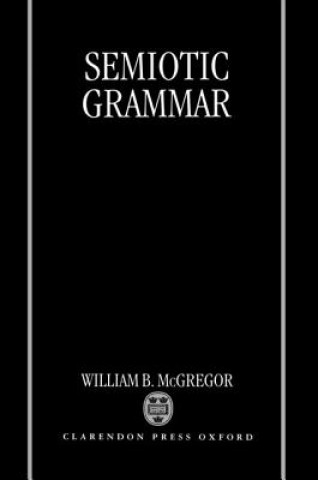
Semiotic Grammar
 Αγγλική
 563 b
563 b
 Παράδοση στην Ελλάδα
Έως 30 ημέρες για επιστροφή
Οι πελάτες αγόρασαν επίσης















 /
/
 Χαρτόδετο
 29.75
€
29.75
€













The label 'semiotic grammar' captures a fundamental property of the grammars of human languages: not only is language a semiotic system in the familiar Saussurean sense, but its organizing system, its grammar, is also a semiotic system. This proposition, explicated in detail by William McGregor in this book, constitutes a new theory of grammar. Semiotic Grammar is 'functional' rather than 'formal' in its intellectual origins, approaches, and methods. It demonstrates, however, that neither a purely functional nor a purely formal account of language is adequate, given the centrality of the sign as the fundamental unit of grammatical analysis. The author distinguishes four types of grammatical signs: experiential, logical, interpersonal, and textural. The signifiers of these signs are syntagmatic relationships of the following types, respectively: constituency, dependency, conjugational (scopal) and linking (indexical, connective). McGregor illustrates and exemplifies the theory with data from a variety of languages including English, Acehnese, Polish, Finnish, Japanese, Chinese, and Mohawk; and from his pioneering research on Gooniyandi and Nyulnyul, two languages of the Kimberleys region of Western Australia.


Πληροφορίες για το βιβλίο
Αγγλική

Χαρίστε αυτό το βιβλίο σήμερα
Είναι εύκολο
1 Προσθέστε το βιβλίο στο καλάθι σας και επιλέξτε παράδοση ως δώρο 2 Ως ανταμοιβή θα σας στείλουμε ένα κουπόνι 3 Το βιβλίο θα φτάσει στη διεύθυνση του παραλήπτηΜπορεί να σας ενδιαφέρει























Γεια σας! Είμαι ο Libroamiko, ο σύμβουλος βιβλίων σας.
Πώς μπορώ να σας βοηθήσω;