
 Επικοινωνία
 Πώς να κάνετε αγορές;
Παράδοση
Οδηγός αγορών
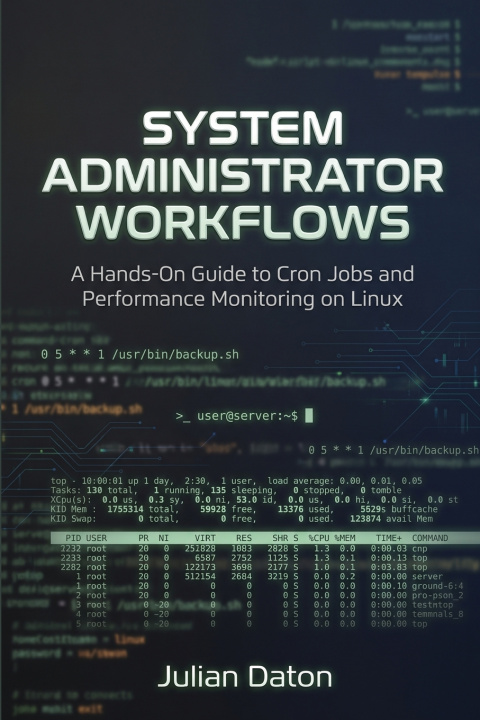
System Administrator Workflows
A Hands-On Guide to Cron Jobs and Performance Monitoring on Linux
 Αγγλική
 51 b
51 b
 Προετοιμαζουμε
 Νέα
Νέα
 Παράδοση στην Ελλάδα
Έως 30 ημέρες για επιστροφή

Turn the blinking cursor into your greatest advantage.
If you have ever stared at a Linux terminal wondering where to even begin, this hands-on guide was built for exactly that moment. System Administrator Workflows takes you from your very first command to running production-ready automation and monitoring systems, without assuming you already speak the language of servers.
You will start with the Linux filesystem, command-line essentials, and how processes and services actually work under the hood. From there, the book moves into real, practical skill-building across six structured parts:
Automation mastery: Learn traditional cron syntax alongside modern systemd timers, and understand exactly when to use each one in real environments.
Logging and visibility: Decode journalctl, traditional syslog files, and log rotation so nothing on your server happens without a trace.
Performance monitoring: Track CPU, memory, disk, and network health using built-in tools like top, htop, free, iostat, and ss, no expensive dashboards required.
Troubleshooting methodology: Follow a repeatable, step-by-step diagnostic workflow used by experienced administrators to isolate bottlenecks in minutes, not hours.
Security and reliability: Apply backup strategies, alerting practices, and hardening techniques that protect production systems from avoidable failures.
Production-ready workflows: Combine everything into a complete, self-sustaining system that monitors and maintains itself.
Written in plain, approachable language and packed with real command examples, checklists, and exercises you can run immediately, this book respects your time and your intelligence. Whether you are a complete beginner, a developer stepping into operations, or an IT professional transitioning into DevOps or cloud engineering, you will find a distribution-independent approach that works whether your servers run Debian, Ubuntu, Red Hat, or CentOS.
By the final chapter, you will no longer be guessing what a command does. You will understand the why behind Linux administration, not just the how, and you will have the confidence to manage real systems responsibly.
Six detailed appendices, including a command reference, a cron expression cheat sheet, and a performance troubleshooting checklist, make this a book you will return to long after your first read.
Stop fearing the terminal. Start commanding it.


Πληροφορίες για το βιβλίο
Αγγλική

Χαρίστε αυτό το βιβλίο σήμερα
Είναι εύκολο
1 Προσθέστε το βιβλίο στο καλάθι σας και επιλέξτε παράδοση ως δώρο 2 Ως ανταμοιβή θα σας στείλουμε ένα κουπόνι 3 Το βιβλίο θα φτάσει στη διεύθυνση του παραλήπτηΓεια σας! Είμαι ο Libroamiko, ο σύμβουλος βιβλίων σας.
Πώς μπορώ να σας βοηθήσω;