
 Επικοινωνία
 Πώς να κάνετε αγορές;
Παράδοση
Οδηγός αγορών
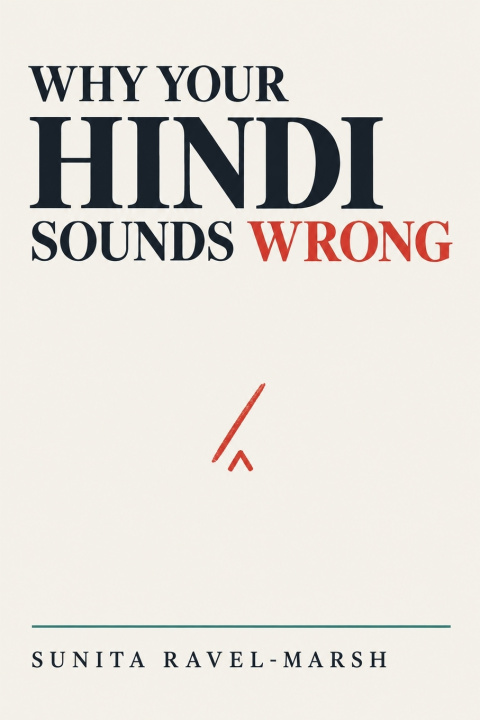
WHY YOUR HINDI SOUNDS WRONG
 Αγγλική
 153 b
153 b
 Προετοιμαζουμε
 Νέα
Νέα
 Παράδοση στην Ελλάδα
Έως 30 ημέρες για επιστροφή

People understand your Hindi. They just pause first. This is the book that tells you why.
Most Hindi courses are staircases: start at the bottom, take every step, never skip one. That is no use at all when you already speak some Hindi and something is quietly wrong with it. You can order food and ask directions, but listeners repeat your sentence back in a slightly different shape before answering. Nobody corrects you. So the fault survives for years.
Why Your Hindi Sounds Wrong is not a course. It is a troubleshooter, organized by the twenty mistakes English speakers actually make - one per chapter - so you can open it at the problem you have and fix that.
Every chapter follows the same shape: the wrong sentence you would say, why your English-trained brain produced it, what a Hindi speaker actually hears, the rule underneath, correct examples with word-by-word glosses and natural translations, the edge cases where the rule genuinely bends, and a short fix-the-sentence exercise with answers.
What's inside:
- Word order, and why the verb has to land last
- The postposition you forgot, and the one you chose wrong
- Gender agreement on adjectives, and on verbs
- The ne construction, explained so it finally stays explained
- Object marking with ko, and when to leave it off
- The four Hindi ways of saying "to have", and how to choose
- tu, tum and aap, and what each one signals
- Requests that come out blunter than you meant
- The continuous where Hindi wants the habitual
- Compound verbs: the ones you leave out, and the ones you pick wrong
- Relative-correlative clauses, the error that actually stops a listener
- Questions, negation, numbers, time expressions, and idioms translated word for word
Two deliberate design choices. All Hindi is in Latin letters - no Devanagari - using one consistent spelling system explained once in Chapter One and held for the whole book, so you can think about grammar instead of script. And where a rule has real exceptions, they are stated, because a rule presented as clean when it is not will fail you exactly when you start to trust it.


Πληροφορίες για το βιβλίο
Αγγλική

Χαρίστε αυτό το βιβλίο σήμερα
Είναι εύκολο
1 Προσθέστε το βιβλίο στο καλάθι σας και επιλέξτε παράδοση ως δώρο 2 Ως ανταμοιβή θα σας στείλουμε ένα κουπόνι 3 Το βιβλίο θα φτάσει στη διεύθυνση του παραλήπτηΓεια σας! Είμαι ο Libroamiko, ο σύμβουλος βιβλίων σας.
Πώς μπορώ να σας βοηθήσω;