
 Επικοινωνία
 Πώς να κάνετε αγορές;
Παράδοση
Οδηγός αγορών
 Αγγλική
 137 b
137 b
 Νέα
Νέα

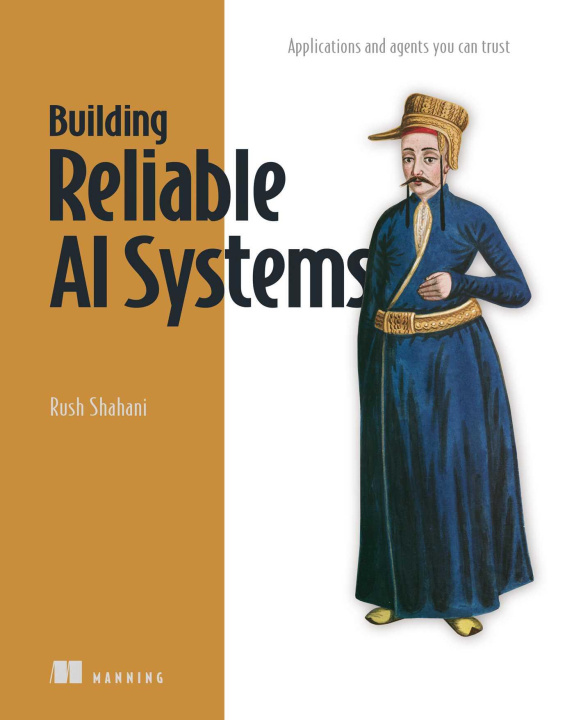
Get the eBook free when you register your print book at Manning.Practical, comprehensive, and urgently needed. Samer Hamad, Amazon This book shows you how to grow a promising prototype into a production product you can deliver, maintain, and scale. In 11 sharply-focused chapters, it walks you through a unique reliability process that author Rush Shahani refined while building an AI-powered sales intelligence platform used by over 15,000 go-to-market teams. Timely and practical, this book provides concrete steps to eliminate costly hallucinations, streamline computational resources, and confidently deploy secure, trustworthy, and compliant AI solutions. Youll immediately appreciate how Building Reliable AI Systems defines AI reliability along six critical dimensionsaccuracy and grounding, safe agency, graceful failure, consistency, fairness, and operational efficiencyand provides a specific three-layer framework to achieve these goals. The first layer, with a focus on outputs, shows you how to get consistent and accurate responses using well-engineered prompts, RAG, and model customization. The second layer, about agents, establishes parameters for memory, tool usage, and orchestration in agentic systems. The book concludes with the third layerReliable Operationscovering deployment, monitoring, and responsible AI. The books reliability framework emphasizes the symbiotic relationship between evaluation and reliability, proving that you cannot improve what you do not measure. Youll learn to measure your applications using fine-grained LLM-native evaluation rubrics like the Grounding Defect Rate, Hallucination Severity Score, and FActScore that audit everything from RAG outputs to the entire step-by-step reasoning trajectory of autonomous agents. Building Reliable AI Systems stays rooted in reality from start to finish. As you go, you will build several projects, including a multi-agent travel planner and a medical assistant, and use industry standard tools and specifications like LangGraph and MCP. In the helpful appendices youll find a handy reference architecture and decision-making checklists. Reviewer Mohamed Zohir Koufi, Lead AI Engineer at Capgemini, praises how the book brings together architecture, tooling, evaluation, and governance in the way real systems are built. By taking this comprehensive approach to LLMOps, the book delivers a reproducible process to ensure your applications stay cost-effective, fast, and compliant with enterprise standards like HIPAA and GDPR. What's inside Ground outputs in real business data Orchestrate safe, consistent multi-step agent workflows Implement robust monitoring, semantic caching, and multi-model fallbacks About the reader For Python-fluent software engineers and data scientists ready to build production-grade, reliable AI applications. About the author Rush Shahani is an AI leader who has spent his career shipping machine learning systems that hold up under real-world conditions. He co-founded Persana AI, a Y Combinator-backed sales intelligence platform that has joined forces with Rox. Before Persana, Rush built AI and search systems at LinkedIn and Element AI (acquired by ServiceNow), and backend and payments infrastructure at Shopify. Table of Contents 1 AI reliability: Building LLMs for the real world Part 1 2 Generating trustworthy responses with prompt engineering 3 Grounding outputs with RAG 4 Embeddings and vector search 5 Fine-tuning LLMs for improved performance Part 2 6 Creating effective AI agents 7 Tool integration and MCP 8 Multi-agent systems Part 3 9 Evaluation and performance for LLMs and agents 10 Deploying and monitoring 11 Bias, privacy, and responsible AI


Πληροφορίες για το βιβλίο
Αγγλική

Χαρίστε αυτό το βιβλίο σήμερα
Είναι εύκολο
1 Προσθέστε το βιβλίο στο καλάθι σας και επιλέξτε παράδοση ως δώρο 2 Ως ανταμοιβή θα σας στείλουμε ένα κουπόνι 3 Το βιβλίο θα φτάσει στη διεύθυνση του παραλήπτηΓεια σας! Είμαι ο Libroamiko, ο σύμβουλος βιβλίων σας.
Πώς μπορώ να σας βοηθήσω;